
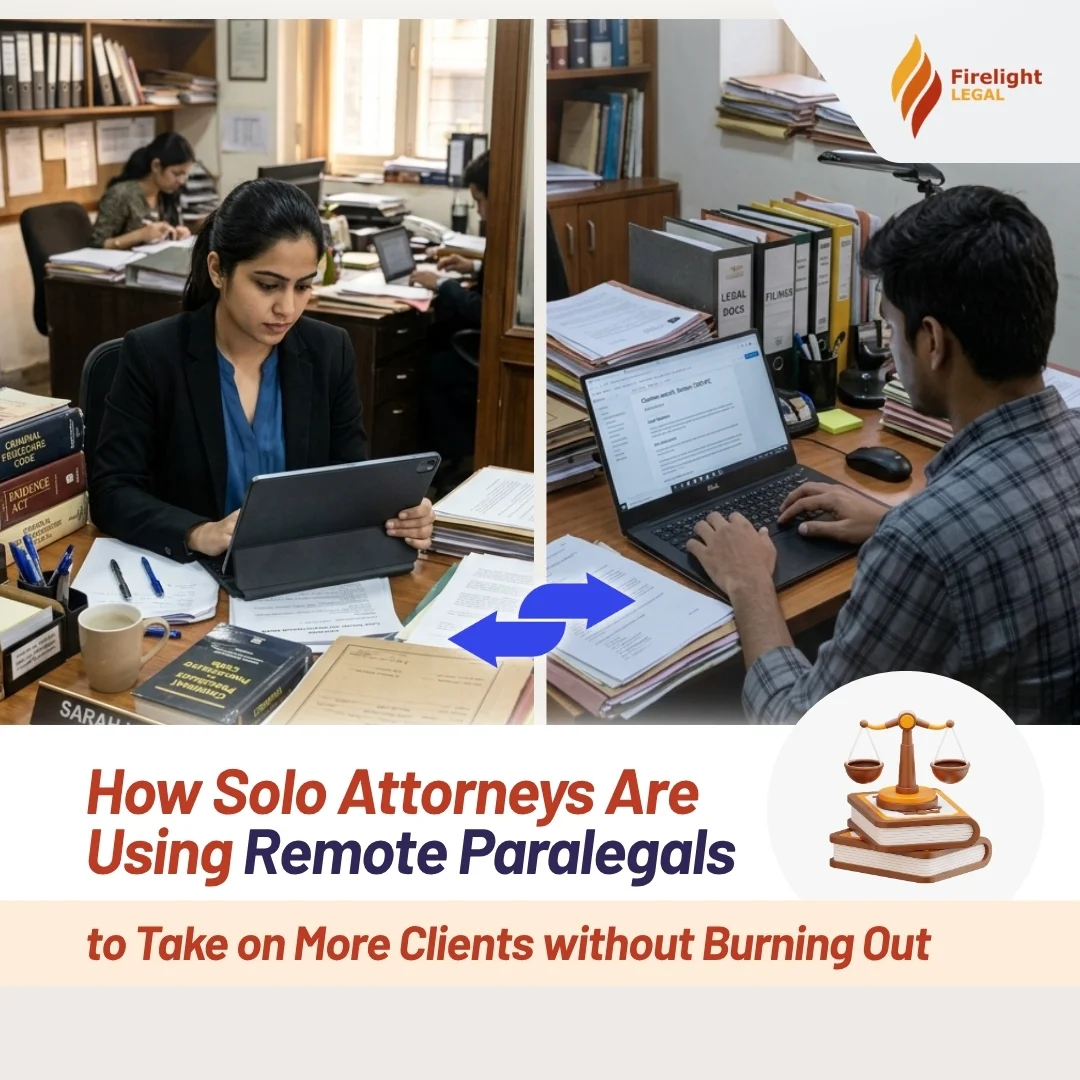
Solo lawyers struggle mostly because there are not enough hours in the day. They handle everything alone, from legal work to billing and marketing. Running a solo firm can become stressful and exhausting. To earn more, they need more clients, but more clients also mean heavier workloads, slower service, and less personal time.
Fortunately, innovative solo practitioners are breaking free from this cycle. Instead of taking on the massive financial risk and high overhead of hiring full-time, brick-and-mortar staff, they are leveraging an agile virtual model. By integrating a dedicated remote paralegal for solo attorney workflows and tapping into on-demand remote paralegal support, solo lawyers are scaling their practices, maximizing their billable hours, and reclaiming their weekends.
Traditional In-House Hiring
When case volumes increase, the reaction for many lawyers is to publish a job posting for a full-time, in-house paralegal. However, for a solo practitioner, traditional employment can feel like a financial anchor.
Consider the actual costs associated with a full-time, on-site employee:
- A competitive base salary and mandatory payroll taxes.
- Health insurance, retirement matches, and paid time off.
- Physical office space, commercial furniture, and dedicated hardware.
- Substantial legal tech software licensing fees.
If your firm hits a quiet quarter or experiences a sudden seasonal dip in case filings, that heavy, fixed monthly overhead remains completely unchanged. You still have to fund that salary even if your cash flow tightens. This inherent financial risk causes many solo attorneys to reject the idea of hiring help altogether, choosing instead to pull all-nighters and handle complex document preparation completely on their own.
Remote Paralegal Support: From Fixed to Variable Costs
The remote contract model is best for law firm economics. Utilizing a paralegal for solo attorney needs allows you to convert a risky fixed operational expense into a predictable, highly flexible variable cost. Instead of paying for 40 hours of attendance every single week regardless of your active caseload, you pay exclusively for productive, billable hours spent working directly on your clients’ files.
If you are entering an intensive multi-week trial preparation phase, you can scale your remote paralegal support up to 30 or 40 hours a week to manage the document load. Once the trial concludes and your schedule normalizes, you can scale that support back down to 5 or 10 hours a week for basic case maintenance.
Tasks to Delegate to a Virtual Paralegal
Under U.S. law, any substantive task that a lawyer would normally perform, but which does not strictly require an independent law license can be ethically delegated to an experienced paralegal. Solo attorneys routinely offload several core workflows to their remote team members:
Complex Document Preparation
Instead of spending your evenings drafting standard pleadings, initial discovery requests, or routine motions from scratch, your remote paralegal can compile the initial drafts. They organize the foundational facts, integrate your firm’s preferred templates, and deliver a polished document ready for your final legal review.
Medical and Fact Chronologies
In personal injury, medical malpractice, or family law cases, organizing thousands of pages of raw data is an enormous drain on an attorney’s focus. Remote paralegals are experts at reviewing dense medical records or financial statements, flagging inconsistencies, creating exhaustive timelines, and summarizing deposition transcripts into actionable insights.
Advanced Legal Research
When a nuanced legal question arises during litigation, you do not need to spend hours tracking down case law yourself. A skilled remote paralegal can dive into databases like Westlaw or LexisNexis, analyze relevant state and federal statutes, locate controlling judicial precedents, and draft clear internal research memoranda that outline the core strengths and vulnerabilities of your position.
Staying Compliant: Ethics, Supervision, and the ABA
Transitioning your firm to a virtual support environment is incredibly efficient, but it must be executed with a strict adherence to legal ethics. As a solo practitioner, you bear professional and legal liability for every document, email, and piece of work generated under your firm’s brand.
The American Bar Association (ABA) has laid down clear frameworks for virtual operations. When building out a remote workflow, you must design your procedures around three fundamental ethical guidelines:
Managerial and Supervisory Duties (Model Rules 5.1 & 5.3)
Under ABA Model Rule 5.3 (Responsibilities Regarding Nonlawyer Assistance), a lawyer who holds direct supervisory authority over a non-lawyer assistant must make reasonable efforts to ensure that the person’s conduct is completely compatible with the professional obligations of the lawyer.
Furthermore, ABA Formal Opinion 498 (Virtual Practice) explicitly states that lawyers practicing virtually or supervising remote personnel must maintain regular, structured interaction and communication. You cannot simply hand over a client file and check out; you must actively guide the remote paralegal, provide explicit instructions, and apply your independent legal judgment to review and approve every piece of work product before it is served or filed.
Safeguarding Client Confidentiality (Model Rule 1.6)
Model Rule 1.6 mandates that a lawyer must make reasonable efforts to prevent the inadvertent or unauthorized disclosure of, or unauthorized access to, information relating to the representation of a client. Because your paralegal is working from an off-site location, you must implement strong digital security measures:
- Mandate multi-factor authentication (MFA) across all firm applications.
- Require your remote staff to access files via a secure Virtual Private Network (VPN).
- Enforce the use of a secure, encrypted cloud-based Case Management System (CMS) with dedicated, individual user profiles.
- Ensure the signing of a comprehensive Non-Disclosure Agreement (NDA) before sharing any sensitive client data.
Preventing the Unauthorized Practice of Law (UPL)
While a remote paralegal can handle advanced substantive tasks, they are strictly prohibited from practicing law independently. To protect your practice and remain compliant with state UPL statutes, make sure your remote support professional never provides legal advice to a client, negotiates or sets client fee structures, signs court pleadings, or appears on behalf of a client at a formal court hearing.
Four Steps to Integrate a Virtual Paralegal Successfully
Successfully shifting to a remote support model requires moving away from informal, verbal delegation and adopting structured, cloud-based systems.
- Deploy a Secure Cloud Platform
Consolidate your firm’s records into an encrypted, ABA-compliant practice management system (such as Clio, MyCase, or PracticePanther). Generate a unique, restricted user account for your remote paralegal to track file modifications and history.
- Establish Structural Communication Routines
Avoid long, disorganized email chains that lead to missed details. Establish a primary communication hub (such as a secure internal firm messenger or project boards) and hold a brief, recurring weekly sync to align on deadlines and file priorities.
- Provide Complete Style Guides and Templates
When assigning a new drafting task, always clarify the expected scope. Share your preferred document templates, local court procedural rules, relevant background context, and past approved filings to minimize the need for heavy revisions.
- Enforce an Attorney Review Gate
Maintain strict compliance by reviewing all drafted materials before they are finalized. Utilize digital redlining, track changes, or comment features to provide feedback, ensuring your independent legal judgment guides the final product.
Conclusion
Choosing to practice as a solo attorney should never mean sacrificing your health, your peace of mind, or your family time on the altar of your career. You do not need to assume the heavy financial risk of a physical office and full-time payroll to take your firm to the next level. Let a skilled virtual professional manage the intensive research, initial documentation, and discovery analysis, freeing you up to focus on what you do best: advising your clients and winning your cases, completely on your own terms.
FAQs
Q1. How can a solo attorney ethically supervise a paralegal who works completely remotely?
According to ABA Formal Opinion 498, attorneys can fully comply with their supervisory duties under Model Rule 5.3 by establishing clear digital policies, utilizing secure cloud communication tools, keeping up regular interactions, and reviewing and approving all drafted legal work before it leaves the firm.
Q2. Is a remote paralegal’s time billable to the client under U.S. law?
Yes. The U.S. Supreme Court affirmed in Missouri v. Jenkins that substantive legal work performed by a paralegal can be billed directly to clients at prevailing market rates, making them a direct source of revenue rather than an administrative expense.
Q3. What is the difference between a virtual assistant and a remote paralegal?
A general virtual assistant handles basic administrative tasks like answering phone lines, scheduling client appointments, and managing standard email correspondence. A remote paralegal is a trained professional who performs advanced, substantive legal tasks such as primary legal research, medical chronologies, and initial document drafting.